
Operation
The two microphone signals (front and rear) are routed to separate channels and summed together. The sum signal is then distributed over the stereo channels as usual using the pan control.
-
The pan control of both channels has to be aligned
identically for correct operation.
Pick-up pattern Setting Omni-directional 
Set the amplification to the same value in both channels. 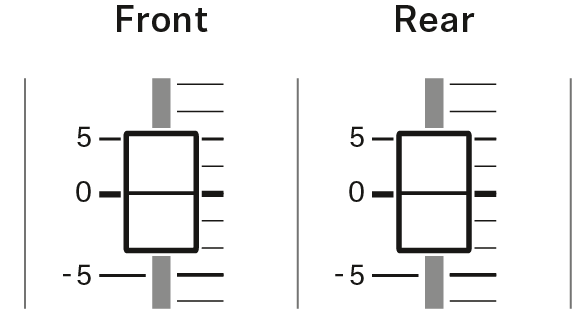
Wide cardioid* 
Set the amplification in the rear channel lower than in the front channel. 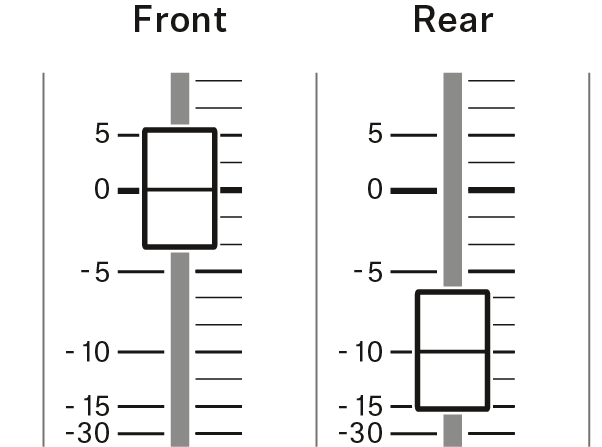
Cardioid 
Activate the front channel only. 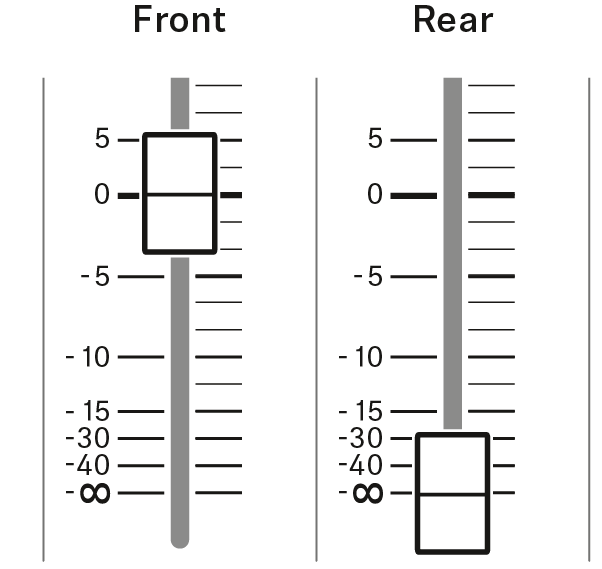
Figure-8 
Set the amplification to the same value in both channels. 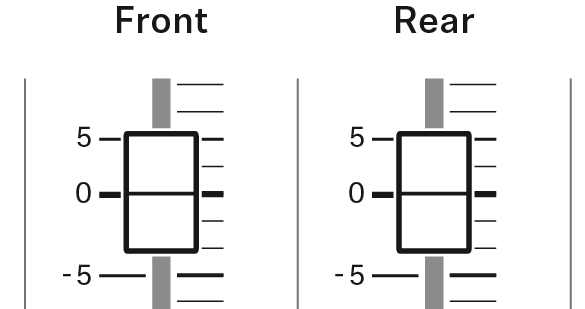
Invert the phase of the rear channel.
Super-cardioid** 
Set the amplification in the rear channel lower than in the front channel. 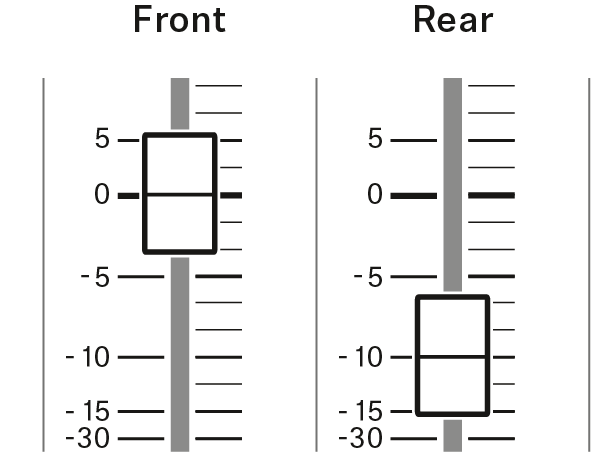
Invert the phase of the rear channel.*Wide cardioid: Pattern between omni-directional and cardioid
The wide cardioid pattern of the MKH 800 is, for example, the result if the rear channel has 10 dB less amplification than the front channel. The pick-up pattern becomes more omni-directional at higher amplification and more cardioid at lower amplification.
At the same time, the rear attenuation (180° attenuation) of the microphone changes. It is the direct result of the amplification ratio between the front and the rear channel, i.e. 10 dB in the example of the wide cardioid pattern.
**Super-cardioid: Pattern between cardioid and figure-8
The super-cardioid pattern of the MKH 800 is, for example, the result if the amplification of the rear channel is 10 dB lower than that of the front channel and if the phase of the rear channel is inverted. At higher amplification, the pick-up pattern tends towards the figure-8 pattern, otherwise the pattern becomes more cardioid.
The cancellation angle at which the microphone is especially insensitive also changes. It is 180° in the case of the cardioid pattern, 120° for the super-cardioid pattern and 90° for the figure-8 pattern. If the MKH 800 TWIN is used as a supporting microphone, the attenuation between different groups of instruments in an orchestra can for example be optimised in this way. Here, too, the rear attenuation is the result of the amplification ratio between the front and the rear channel, i.e. 10 dB in the case of the super-cardioid pattern.
As a result of the symmetry of the microphone, it is also possible to create any desired rear pick-up pattern. For this purpose the microphone signals are additionally routed to two other channels, whereby front and rear channel exchange roles. The settings are then made in the same way as described above and the rear pick-up patterns can be freely selected. Both pick-up patterns are then available simultaneously, for example for a surround front channel and a surround rear channel. With two MKH 800 TWIN, four surround channels can be created in this way.
If only the cardioid pick-up pattern is required for the front and rear channels, the microphone signals can also be used directly. This minimises the necessary effort.
With an MKH 800 TWIN and a figure-8 microphone (e.g. MKH 30) full surround-sound recording using the double MS technique (MSM) can be done. As is common with the MS technique, the figure-8 microphone is positioned above the MKH 800 TWIN and directed to the left. The front and rear left and right surround channels are produced by matrixing the figure-8 signal and the front and rear signals of the MKH 800 TWIN.
By combining the front and rear signals of the MKH 800 TWIN, a centre channel with any pick-up pattern can be achieved and even a centre rear channel is possible if required. In spite of the wide range of options, postproduction still only requires the original microphone signals to be saved, i.e. only three signals for five or six surround channels.